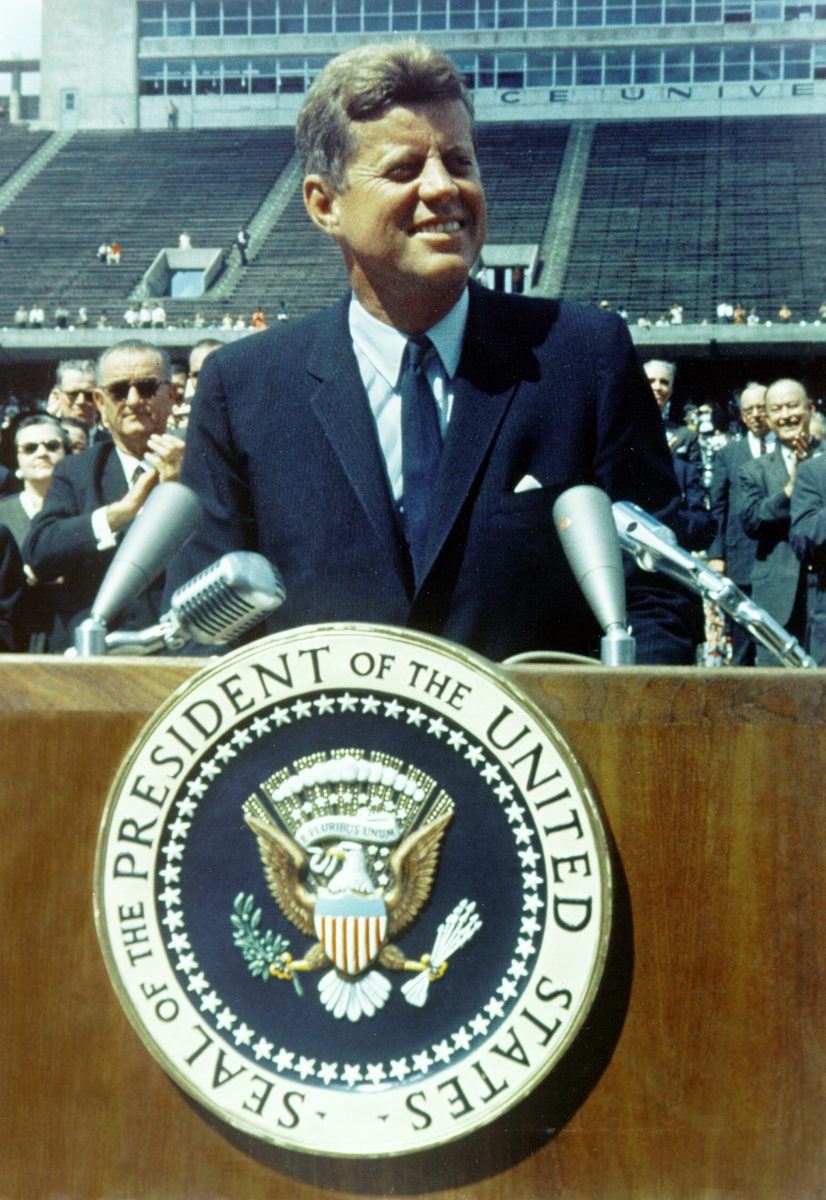
President John F. Kennedy’s September 1962 “go to the Moon” speech stands as one of the most consequential calls to action in modern American history. Delivered at Rice University, it challenged the nation to achieve what seemed impossible—to land a man on the Moon and return him safely to Earth within the decade. Building on his address to Congress months earlier, the speech crystallized a national commitment to an ambitious idea, disciplined execution, and perseverance at a pivotal moment in the Cold War.
At the time, the United States faced mounting pressure from the Soviet Union, which had surged ahead in space—from the 1957 launch of Sputnik to placing the first human in orbit. Kennedy understood that space was not merely symbolic—it was strategic. Leadership in space meant advantages in national security, technological achievement, and global influence. Success required aligning political will, public support, and sustained funding behind a clear goal. Beginning with Project Mercury and Gemini and culminating in the Apollo program, the effort showed how incremental, milestone-driven progress can turn an audacious vision into reality.
The impact extended far beyond the Moon landing. Robust investment in space catalyzed a broad technological ecosystem—advancing scientific research, commercial applications, and military capabilities. Institutions like NASA became global symbols of innovation, and the United States cemented its position at the forefront of science and engineering. Kennedy’s vision also affirmed a central role for government in accelerating technological innovation.
Today, as the United States prepares to return to the Moon, the speech resonates anew. The strategic landscape has shifted, with China emerging as a formidable competitor in space. Like the Soviets before them, Chinese leaders recognize the military, economic, and geopolitical advantages the domain confers. China’s rapid expansion in launch capability, satellite networks, and lunar ambitions underscores that we’re once again competing for the mantle of global leadership in space. For the United States to prevail, it must again marshal resources, galvanize the public, align policy, and demonstrate committed leadership—not simply to “go to the Moon,” but to sustain a continuous presence there.
Yet Kennedy’s legacy is not solely one of rivalry. In remarks before the United Nations General Assembly, months before his assassination, he proposed collaboration with the Soviets in space—an idea that eventually led to the Apollo-Soyuz “handshake in space” in 1975. This dual vision remains relevant today. As space grows ever more central to global influence and human progress, Kennedy’s speech endures as both a blueprint for achieving the extraordinary and a reminder that even though competition will continue to define the domain, cooperation always remains possible.