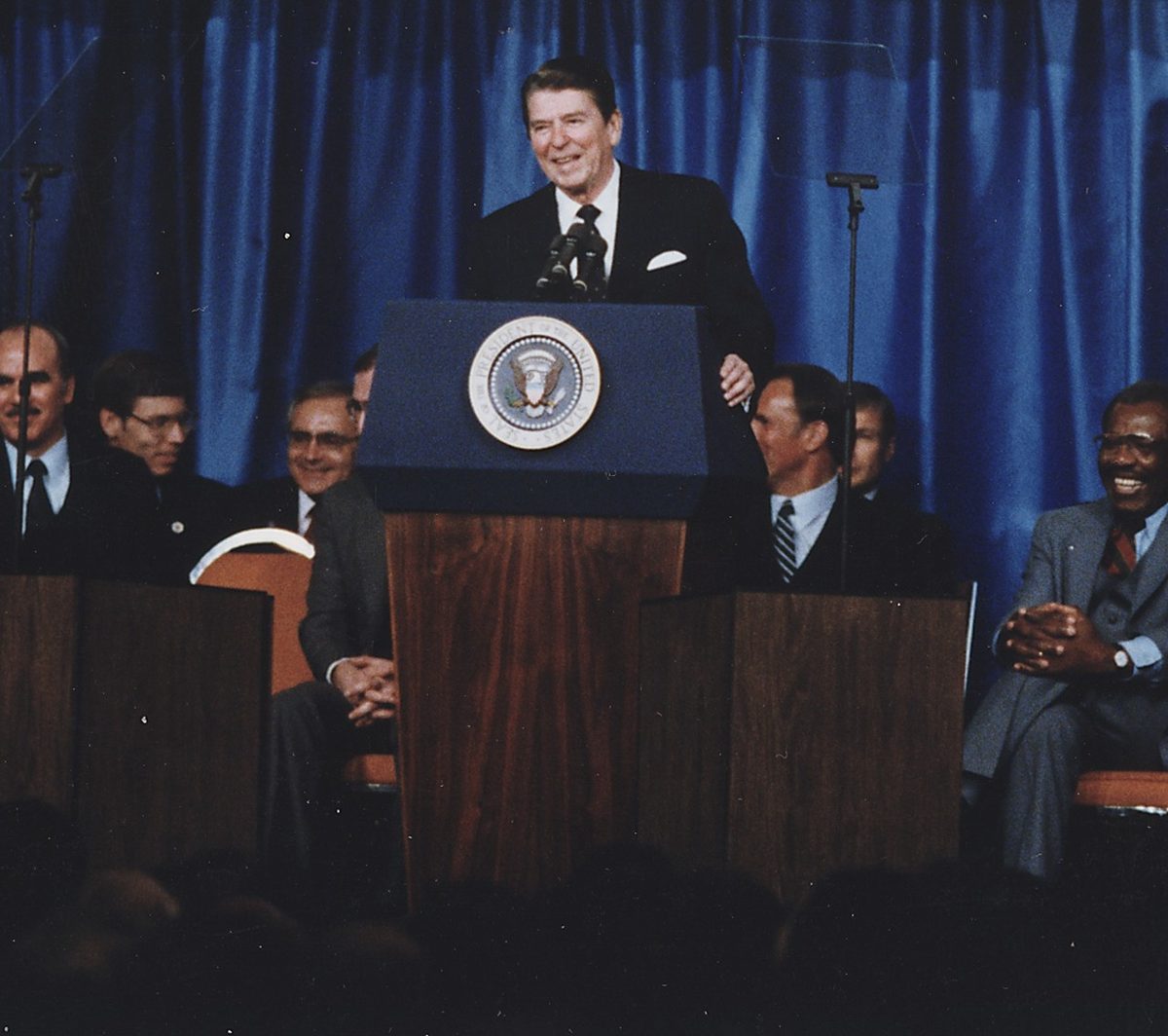
On March 8, 1983, President Reagan traveled to Orlando, Florida to address the National Association of Evangelicals. The timing of the speech and its audience was carefully selected. In late 1982, Congress voted against funding the MX missile, the centerpiece of Reagan’s nuclear modernization program. A skeptical Congress was emboldened by support from the nuclear freeze movement—an alliance of antinuclear activists and religious figures who opposed Reagan’s goal to restore nuclear parity through a nuclear buildup.
Reagan understood he could not realize nuclear arms reductions with the Soviets unless the MX was deployed. A crucial MX vote was just months away in May 1983, and addressing the National Association of Evangelicals was Reagan’s attempt to disarm religious leaders and his congressional skeptics.
The appearance was classified as a domestic policy speech, meaning it did not go through the usual State Department and National Security Council review process. Unencumbered, Reagan delivered an unbridled appeal to the religious community about the morality of his nuclear program.
Though often overlooked, the first half of his speech was domestically focused and captured Reagan’s commitment to recognizing and sustaining America’s fundamental goodness. He cited Alexis de Tocqueville’s observation that “America is good. And if America ever ceases to be good, America will cease to be great.” Reagan told the leaders, “I’m pleased to be here today with you who are keeping America great by keeping her good.”
Then, Reagan transitioned to the Soviet Union. He urged the religious leaders in the audience to “speak out against those who would place the United States in a position of military and moral inferiority” and to resist “the temptation of blithely declaring yourselves above it all and label both sides equally at fault, to ignore the facts of history and the aggressive impulses of an evil empire, to simply call the arms race a giant misunderstanding and thereby remove yourself from the struggle between right and wrong and good and evil.”
No president had spoken so frankly about the nature of the Cold War and provided such a candid assessment of the Soviet Union’s legitimacy. Both the Soviets and western media lambasted Reagan. They said describing the Soviet Union as the “evil empire” was unnecessarily confrontational.
The “Evil Empire” speech is now regarded as prescient, and Reagan is praised for his bold statesmanship because he personally inserted the phrase into the speech. However, Reagan was articulating his long-held views on the Cold War and the Soviet Union. For Reagan, the Cold War was primarily an ideological struggle between freedom and tyranny, and the “Evil Empire” speech was another chance to share those views with America’s religious community.
Today, an array of geopolitical challengers from Beijing, Moscow, and Tehran threaten American interests. Confronting them requires not just military and economic strength, but the same moral clarity espoused by Reagan. Prevailing in renewed great power rivalry demands leaders who are clear-eyed about our adversaries and are willing to confront them on moral grounds.