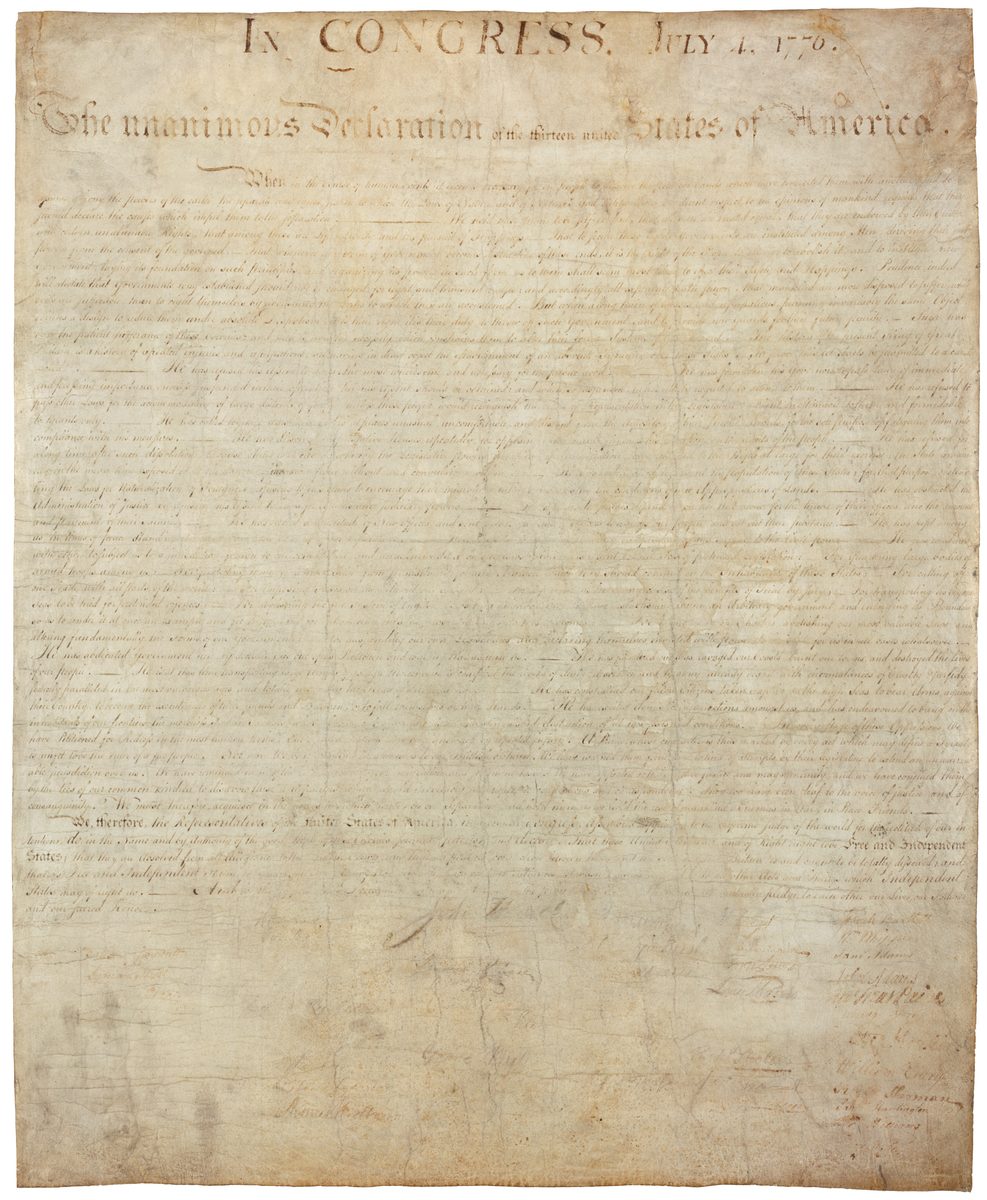
The Declaration of Independence is one of the most consequential documents ever produced. Unanimously adopted by the Continental Congress on July 4, 1776—two days after the body formally declared independence from Great Britain—it proclaimed the United States to be a sovereign, independent nation while articulating the unalienable rights shared by mankind. In doing so, the Declaration also established enduring mandates for U.S. foreign policy.
Most directly, the Founders argued that as an independent nation, the United States must secure the rights of its citizens and defend its territorial integrity. Yet they emphasized prudence in doing so; as the Declaration makes clear, recourse to arms against the British Crown came only after peaceful and diplomatic measures had been exhausted.
Independence also encouraged the United States to engage in formal relations with other nations. The Founders explicitly cited the power to “contract Alliances” as a consequence of sovereignty, underscoring that American independence was made stronger through mutually beneficial partnerships. This legitimacy allowed American diplomats to appeal more effectively to powers such as France and Spain for material support against Great Britain, which ultimately proved decisive in the Revolutionary War.
The Declaration further delineates basic conditions under which Americans expect to be treated by foreign countries and the circumstances that would compel the United States to defend its people. Beyond affirming a government’s responsibility to protect Americans’ unalienable rights to “Life, Liberty and the pursuit of Happiness,” the Founders catalogued specific infringements by a foreign power that would no longer be tolerated: obstructing American representative governance, disrupting American trade and commerce, deploying foreign mercenaries to fight against Americans, and destroying the American way of life. The Declaration sets forth that the primary goal of American national security is the defense of our rights, security, prosperity, and way of life—our direct national interest.
As important, the Declaration articulates the moral principles underlying the American experiment, which necessarily guide how we approach the world. The famous assertion that “all men are created equal” and are endowed with unalienable rights was presented by the Founders as a universal claim, not one confined to colonial America. A commitment to individual freedom and human equality endowed by our Creator, then, must inform America’s conduct at home and abroad. The Declaration thus grounds a legitimate American interest in fostering an international environment more hospitable to protecting these unalienable rights as the Founders conceived them, short of any obligation to moralize nations or override other peoples’ right to self-determination. In this sense, the Founders foreshadowed a broader vision of U.S. foreign policy that dovetails protecting America’s direct material interests with a broad defense of Western moral principles: America’s enlightened self-interest.
Although the Founders could not have anticipated the magnitude and scope of American foreign policy 250 years later, the Declaration of Independence chartered this American conception of foreign policy and the principles that should guide it. The responsibility rests on successive generations of American leaders to apply the Declaration’s principles artfully in service of a strong and proud U.S. foreign policy.