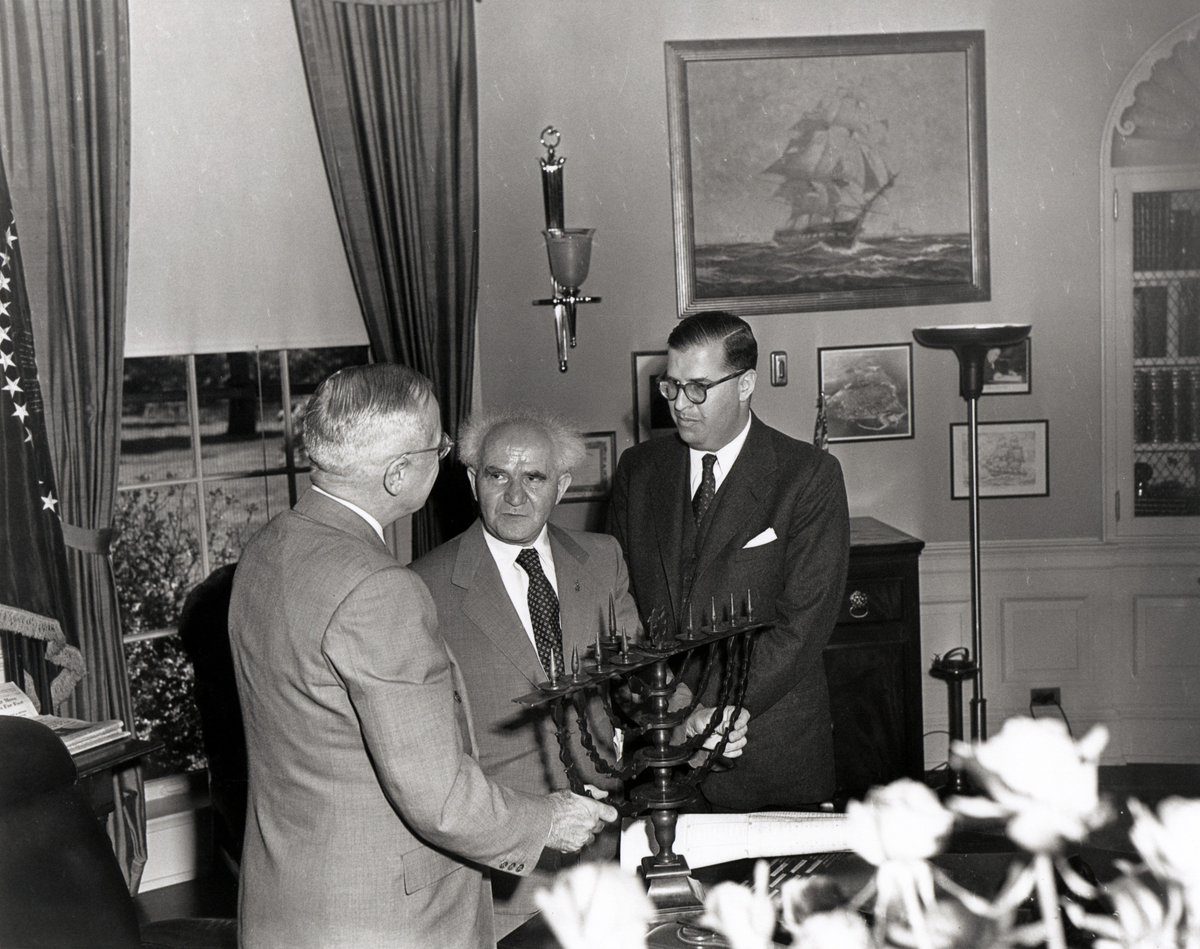
The road to Israeli independence was a long and difficult one, lasting at the very least from the Balfour Declaration of 1917 to Israel’s Declaration of Independence on May 14, 1948. And so was the road to recognition of Israel that very day.
There was a long history of Christian Zionism in the United States, and the pattern was set in the nineteenth century: considerable support from members of Congress, newspaper, business and finance leaders, and leading lawyers, for a Jewish state in Palestine was met with a great deal of resistance in official Washington, especially at the State Department. Congress adopted a joint resolution in 1922 saying it “favors the establishment in Palestine of a national home for the Jewish people,” and in the 1930s and 1940s—when a home for stateless Jews facing Nazi persecution would have saved many lives—the American Jewish community became solidly Zionist. Nevertheless the U.S. Government did nothing to advance the cause, in good part for fear of antagonizing Arab allies.
This indifference and in some cases hostility to establishment of a Jewish state characterized the Roosevelt administration but not the attitude of Harry Truman. Truman sought to balance a genuine desire to help the stateless Jews who emerged alive from the Holocaust against a resistance to any action that might draw the United States into Middle Eastern conflicts. There was strong bureaucratic resistance to a Jewish state; as historian Jeffrey Herf wrote, “A broadly shared consensus that establishment of the Jewish state in Palestine was at cross purposes to the Cold War and to American access to Arab oil.”
The United Nations voted on November 29, 1947, for partition of Britain’s Palestine Mandate (established after the First World War) into one Arab and one Jewish state. When Britain decided to end the Mandate on May 14, 1948, and it became clear that the Jewish Agency would declare independence, what would the United States do? Congress and President Truman supported partition and recognizing the new Jewish state, but the bureaucracy remained opposed—led by Secretary of State George Marshall. In a showdown in the Oval Office on May 12, 1948, with only hours left, Marshall argued forcefully against recognition. Marshall thought the Jews would be overrun and had told the Jewish Agency’s representative in Washington that if the Jews got into trouble “and came running to us for help, they were clearly on notice that there was no warrant to expect help from the United States….” He even delivered a threat: if Truman recognized Israel, he said, “and if I were to vote in the election, I would vote against you.” Given Truman’s poor polls at that time, a resignation or public opposition by the prestigious Marshall could have meant defeat.
But Truman was not swayed, agreeing with the moral and historical arguments his White House Counsel Clark Clifford made at the meeting. Eleven minutes after Israel declared independence, the United States recognized it; Truman was the first world leader to do so. The dry statement from Washington said this:
This Government has been informed that a Jewish state has been proclaimed in Palestine, and recognition has been requested by the provisional Government thereof. The United States recognizes the provisional government as the de facto authority of the new State of Israel. Statement by President Truman, May 14, 1948
Truman had a better understanding of the Middle East than many of his advisers, and presumably did not think either that the new Jewish state would be instantly overrun or that it would be impossible to maintain friendships in the Arab world while recognizing Israel. Those few formal words of recognition opened the door to a relationship that, while distant from 1948 to 1967, has since that date grown increasingly close and is now at the center of U.S. policy in the Middle East.