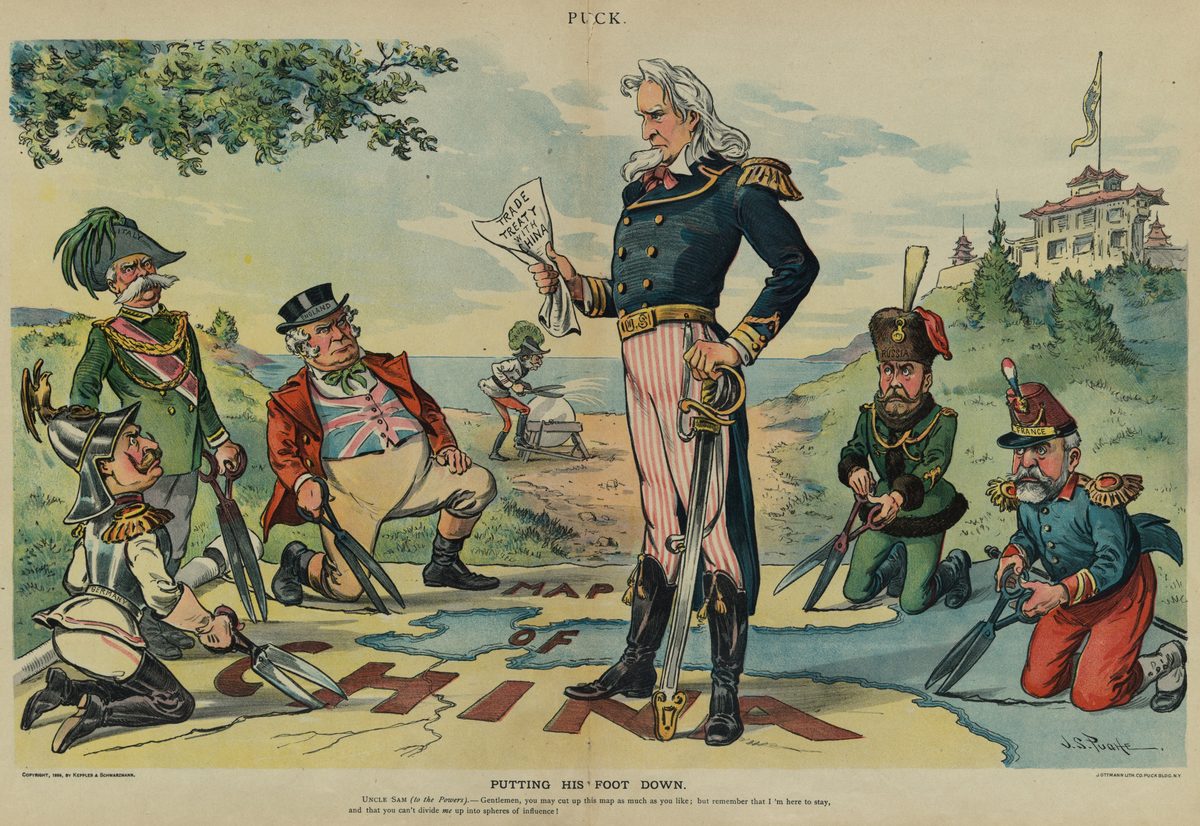
Throughout the 1890s, the Qing dynasty faltered as European empires and Japan established footholds in China. During the ensuing scramble for China, American leaders grew concerned that Germany, Britain, Russia, France, and Japan might establish exclusive spheres of influence and undermine U.S. economic access to China, as they had in Africa. Seeking to check their ambitions, in 1899 U.S. Secretary of State John Hay issued notes to all six countries insisting that they should have equal commercial access to China, with each country given non-discriminatory commercial and industrial access. This “Open Door” note established U.S. support for free and open markets with equal trading opportunities for merchants of all nationalities. Although the principle of non-discrimination in commercial activity was not fully embraced, it was tacitly accepted by most of the other great powers.
A year later, the anti-foreigner Boxer Rebellion threatened this tacit agreement, as foreign troops surged into Beijing to rescue their citizens, some securing additional territory along the way. Secretary Hay circulated an additional note calling for the preservation of China’s “territorial and administrative integrity.” Taken together with Hay’s 1899 message, these notes constituted the Open Door policy, marking a shift towards support for free trade and equal economic access in Asia and around the world. The United States thus established itself as a protector of Chinese sovereignty while also furthering its own economic interests. The Open Door policy became a foundational principle of U.S. engagement throughout East Asia, establishing the basic logic of its international economic policy. Today, support for equal commercial access is eroding, but the underlying principles of the Open Door policies have benefited America and American business greatly over the last century and a quarter.