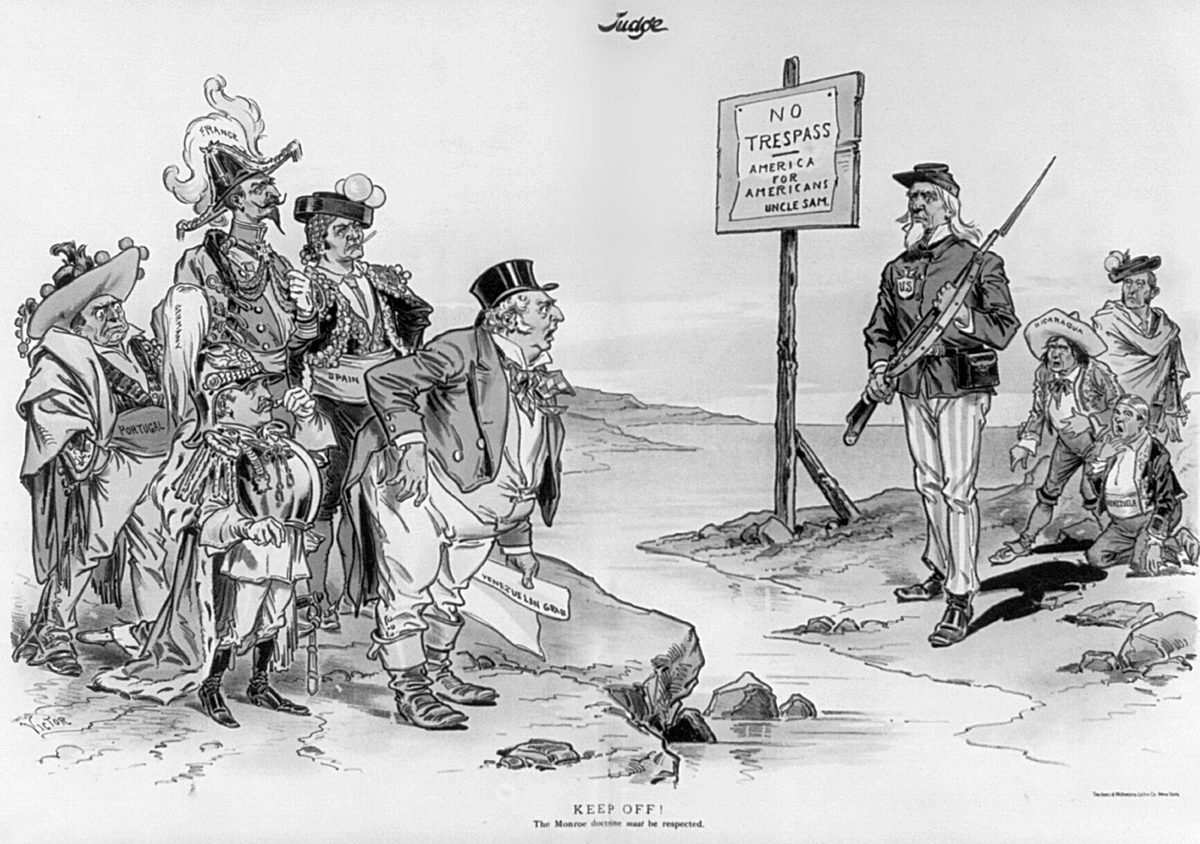
The Monroe Doctrine, articulated by President James Monroe in 1823, declared the Western Hemisphere off-limits to further European colonization or interference, while pledging U.S. non-involvement in European affairs. This policy was, at its core, isolationist—intended to create separate spheres of influence to shield the United States without entangling us in Old World conflicts. Under subsequent Presidents, such as John Quincy Adams, Andrew Jackson, and James Polk, it continued to be invoked defensively, and not as a justification for power projection in the Western Hemisphere.
Even as the United States expanded continentally (i.e., “Manifest Destiny”), presidents such as Ulysses S. Grant and Grover Cleveland upheld the doctrine’s non-interventionist core, avoiding entanglements in Latin American internal affairs.
But by the early 20th century, the Monroe Doctrine was reframed in support of active U.S. interventionism in defense of our national security interests. President Theodore Roosevelt led the charge with his 1904 “Corollary,” which asserted the right to preempt European involvement in Latin America through action. It was used to justify deployment of warships to secure the Panama Canal zone, for military occupation of Cuba, and financial control over the Dominican Republic. Woodrow Wilson continued in the same vein, intervening in Mexico, Haiti, and Nicaragua to promote democracy and counter instability.
While Franklin D. Roosevelt briefly reverted to a less interventionist stance with his “Good Neighbor Policy” in the 1930s, this proved short-lived, and during the Cold War, the Monroe Doctrine was again used to justify multiple anti-communist interventions: Dwight D. Eisenhower backed the 1954 Guatemala coup; John F. Kennedy orchestrated the Bay of Pigs and Cuban Missile Crisis response; Ronald Reagan supported contras in Nicaragua and invaded Grenada in 1983 to remove a Soviet-backed regime there.
Under President Donald Trump, the interventionist version of the Monroe Doctrine has once again taken the fore. The “Trump Corollary” explicitly reasserts U.S. dominance in the Western Hemisphere. U.S. pressure on Panama, the operation to capture Nicolás Maduro in Venezuela, and heavy ongoing pressure on the communist Cuban regime are examples of actions designed to counter Russian and Chinese regional influence. President Trump’s version of the doctrine is a far cry from what Monroe originally intended, and much more in line with that of Theodore Roosevelt and Ronald Reagan.