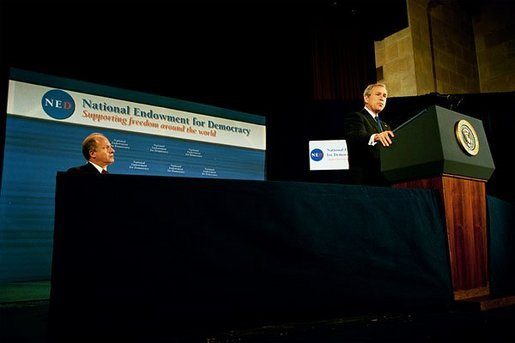
In his 2003 address marking the 20th anniversary of the National Endowment for Democracy (NED), President George W. Bush made a powerful case: the long-term security of the United States depends on the expansion of freedom worldwide. At a time when critics dismissed democracy promotion as unrealistic, unnecessary, or wasteful, President Bush grounded his argument in history. He reminded us that America’s commitment to liberty helped end the Cold War not through catastrophic nuclear conflict but through the peaceful collapse of the Soviet Union and the spread of democracy across Eastern Europe. Sustained U.S. leadership after World War II also helped transform Germany and Japan from militaristic adversaries into stable democratic allies. These successes were part of a broader democratic breakthrough in the late twentieth century, when the number of democracies worldwide grew from roughly 40 in the early 1970s to more than 120 by the early 2000s.
Two decades later, President Bush’s argument carries renewed urgency. Authoritarian countries such as Russia and China are actively working to expand their influence and reshape the international order in ways that weaken transparency, accountability, and individual liberty. Through coercion, propaganda, and political interference, these regimes breed instability, threaten free markets, and undermine the institutions that sustain global peace and prosperity. Supporting freedom abroad is therefore not naïve idealism—it is strategic realism. If the United States retreats from global leadership, the vacuum will not remain empty. It will be filled by anti-American regimes far less committed to peace, stability, and a rules-based international system.
Even as authoritarian regimes seek to tighten their grip, people’s demand for freedom has not disappeared. Around the world, courageous individuals continue to challenge repression at great personal risk. From freedom fighters and independent journalists to civil society and political leaders, these individuals refuse to accept lives governed by fear. Their courage is a powerful reminder that the desire for liberty is universal—and that the United States must continue to stand alongside those who defend it.
President Bush’s NED address also outlined the principles that sustain successful societies: accountable governments, the rule of law that protects liberty, strong civic institutions, and respect for fundamental rights, including religious freedom. Those principles remain as relevant today as they were two decades ago. And institutions like the NED and the International Republican Institute (IRI) play a crucial role in advancing them. Since their establishment in 1983 with strong bipartisan support, NED and IRI have helped strengthen political parties, reinforce electoral integrity, promote fundamental freedoms, improve governance, and empower citizens to hold their leaders accountable.
America cannot retreat from this mission. As President Bush reminded us, democracy is not self-sustaining—it must be defended. And when the United States helps defend it, the world becomes more stable, safe, and free.