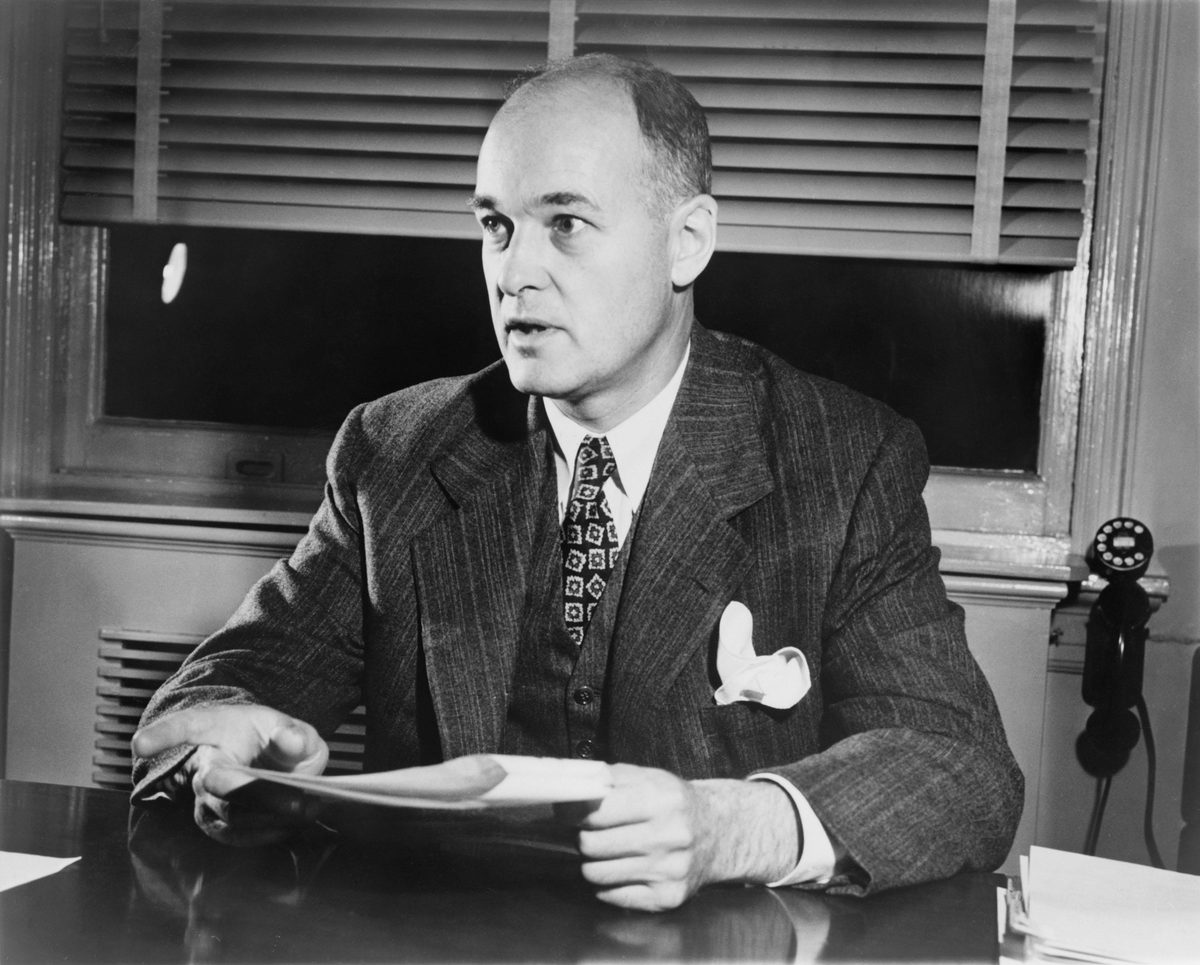
George Kennan’s Long Telegram was not only the most detailed account of the nature of the challenge presented by the Soviet Union at the onset of the Cold War, but it also provided the blueprint for how the United States could properly defend itself against—and ultimately defeat—that challenge.
Hopes that the United States and the Soviet Union could continue to exist as cooperative partners faded quickly after World War II. The State Department tasked George Kennan—chargé d'affaires at the U.S. embassy in Moscow—with providing an explanation as to why the Soviets were refusing American overtures for cooperation. Kennan provided a 5,000-word treatise explaining the cause of the frictions between the Soviet Union and the United States, later joked as being a “flagrant abuse of the telegram system.”
Kennan illustrated that a fusion of Russian historical insecurity and Marxist-Leninist ideology was informing the Soviet worldview. Russia’s lack of natural borders and its history of being invaded fueled a deep distrust of foreign powers. Meanwhile Marxism-Leninism held that there is an implacable competition between the communist and the capitalist worlds, in which Soviet communism would ultimately triumph. Kennan argued that together these dual ideologies generated a deep distrust and animosity towards the powerful, capitalist United States.
This worldview also shaped a Soviet strategy that was both patient and opportunistic. If communism’s triumph over capitalism was inevitable, then time favored the Soviet Union. When faced with firm resistance to overly aggressive moves, it would withdraw and recalibrate. Soviet advances would be subtle and subversive; Kennan described that the Soviet Union would work to exploit divisions within the capitalist world, harness sympathetic “democratic-progressive” elements abroad, and increase the “strength and prestige of Soviet state.”
In response, Kennan articulated that America’s success in the Cold War would “depend on degree of cohesion, firmness and vigor which Western World can muster.” Firmness entailed pushing back against Soviet attempts at expansion, underpinned by a formidable American military deterrent. But beyond firmness, Kennan realized—as did the Soviet Union—that the Cold War was ultimately a test of whether the free and open American system could produce a better society than Soviet communism. Kennan recommended that America leverages founding principles, cultivates domestic unity, and provides opportunities to foster prosperity and liberty abroad. He also urged the government to educate the American people on the Soviet threat and study it.
The Long Telegram offered a middle-ground strategy to defeat the Soviet Union, later defined as containment. Not rollback, which called for aggressive military action against the Soviets; not capitulation, which would make useless concessions; but an approach that fortified Western society, leveraged enlightened American principles at home and abroad, and ultimately achieved success in outlasting and outclassing the Soviet Union.
Kennan’s analysis offers several important lessons for our current challenge against the Chinese Communist Party (CCP). Primarily, the United States must recognize the fundamental differences between us and communist China—interests, values, ideology, and historical insecurities—are also irreconcilable, and our task is to devise a strategy capable of overcoming this adversary, possibly through a modern form of containment. Second, the Long Telegram’s emphasis of maintaining fidelity to American principles and cultivating domestic unity are helpful reminders of the strength of the American project. And third, the United States must educate the American people on the nature of the CCP threat today and prepare them for a long, challenging struggle.